Connecting
Dots
Creating Impact.
Bayan Alzahabi Marketing & PR



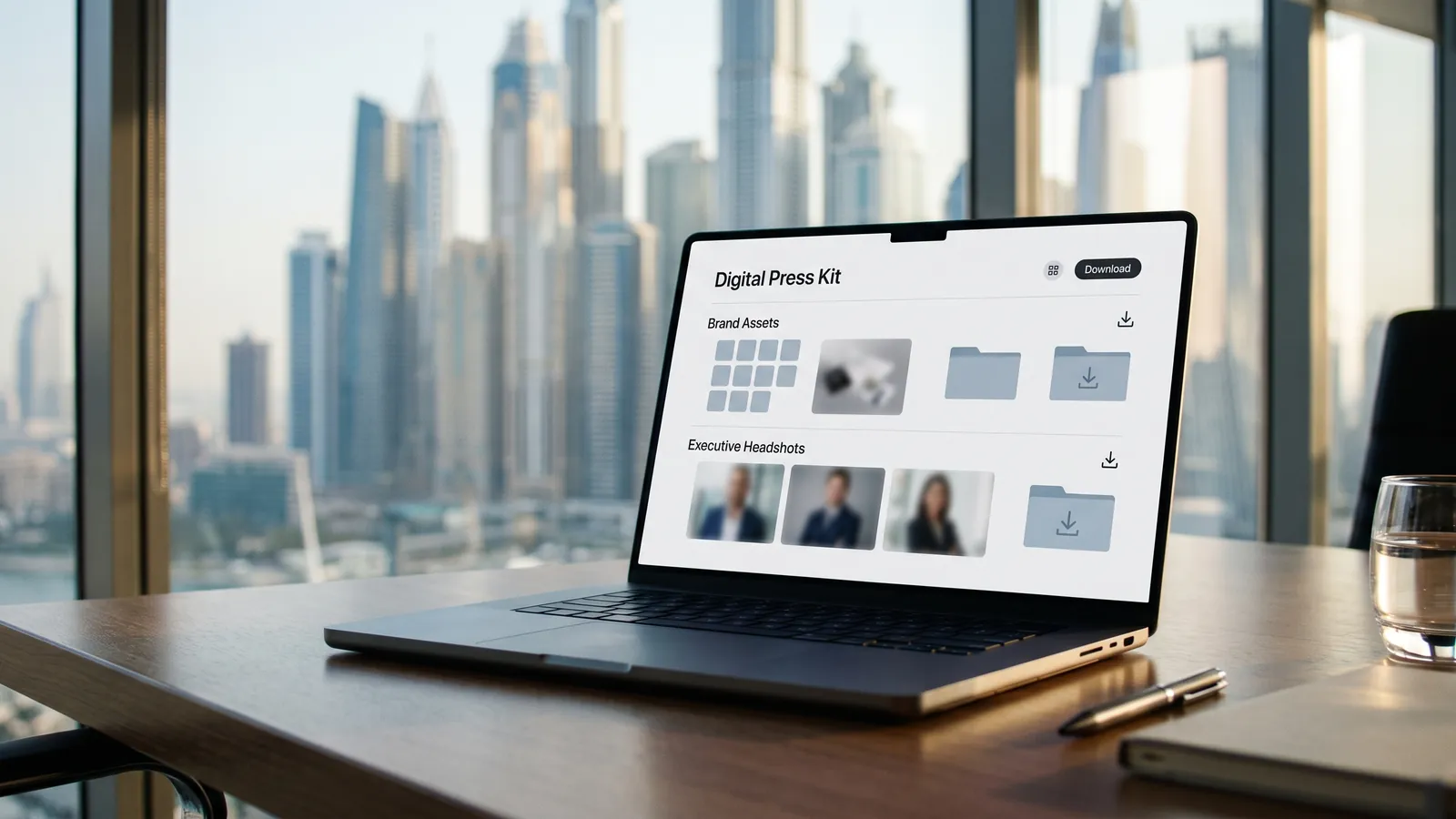
A journalist visiting your website should be able to establish who you are, check an announcement, find a usable image, and contact the right person. A brand newsroom makes those tasks straightforward. It is a working resource for reporting, not simply a gallery of press releases or a second version of the sales homepage.
"A useful press page answers the journalist's next question before asking them to contact you." — BAZ Team
Build around the questions a reporter needs answered
Start with the basics: the company's full name, what it does, where it operates, and who is authorised to speak for it. Distinguish the legal entity from the consumer brand if they differ. Explain unfamiliar products in ordinary language. A reporter should not need to translate your positioning statement into a factual description.
Add a concise company overview with a review date and an accountable owner. Include only facts the business can verify. Claims such as largest, first, or fastest require a clear basis; if that basis is unavailable, describe the operation without the superlative. A short accurate profile is more useful than an impressive but ambiguous one.
Consider the questions particular to your sector. A venue may need location and capacity information; a technology business may need product availability and integration context. Keep these details relevant to reporting rather than reproducing every feature from a brochure. Link to deeper material when a reader needs it.
Separate announcements from background material
Give each announcement a stable page with a clear headline, publication date, full text, relevant images, and a media contact. Make the announcement readable without downloading a document. A PDF can be offered as an additional format, but the essential facts should also be available directly on the page.
Maintain separate areas for company facts, executive biographies, approved images, and frequently requested information. This avoids burying evergreen material beneath a chronological archive. A reporter covering an unrelated story may need an executive photograph rather than your latest launch announcement.
Show meaningful updates transparently. If an announcement is corrected, explain the correction and preserve an intelligible record. Do not silently replace a launch date or financial figure while leaving the original publication date as the only signal. Accuracy and traceability matter more than maintaining the appearance of an untouched page.
Prepare a media kit that is actually usable
Provide clearly named image files with captions, credits, and usage information. Include both an appropriate high resolution version and a lighter preview where practical. State whether a photograph shows a real location, product, event, or an illustration. Avoid requiring a journalist to guess who appears in a group image.
Offer approved logos in suitable formats and explain basic usage constraints. Executive biographies should have a short version and a fuller version, each with current titles. Keep facts consistent with the rest of the website. An outdated job title in a downloaded biography can propagate into coverage long after the main page has been corrected.

Make Arabic and English information equally dependable
Publish corresponding language versions when the announcement is intended for both audiences. Verify names, titles, currencies, dates, and quoted statements across the two versions. Maintain a shared fact sheet so translation does not create competing interpretations of the news.
Give each language a clear navigation route. Readers should be able to switch to the corresponding announcement rather than landing on an unrelated homepage. Check Arabic text direction and mixed language product names in the browser. Downloadable filenames should also be understandable, especially when a kit contains several language versions.
Assign review ownership for both languages. Updating only the English page leaves an older Arabic claim in circulation. A release checklist should identify every associated asset, including biographies, captions, and background documents, so changes travel through the complete package.
Create a reliable media contact route
List a monitored media address and identify what requests it handles. Make sure incoming enquiries reach someone who can coordinate facts and interviews. A generic sales form with mandatory budget fields is an unsuitable route for a journalist on deadline. Where possible, provide a named contact and a clear backup arrangement.
Define an internal response process. Acknowledge receipt, record the reporter's deadline, confirm the subject, and identify the appropriate spokesperson. If the answer requires verification, say when you expect to respond. Do not fill a gap with an unapproved comment merely to appear responsive.
Protect private information while keeping approved press assets accessible. Public media materials should not require unnecessary personal data collection. Confidential briefings and embargoed documents need a separate controlled process; they should not be placed in an unlinked folder and assumed to be private.
Support search and accessibility with clear structure
Use descriptive page titles, meaningful headings, readable body text, and image descriptions that match the content. Keep important facts out of image-only layouts. A reporter copying an executive name or checking a date should be able to access ordinary text rather than extract it from a graphic.
Check internal links and downloads regularly. A media kit with expired cloud links or missing images creates work at the moment the brand is trying to be helpful. Stable URLs also make it easier for journalists to cite source material and for colleagues to share the same authoritative page.
For a small business, a well-maintained page can be enough. Do not build an elaborate newsroom taxonomy before there is material to support it. Start with the essential assets and expand the structure when the volume of announcements and background resources justifies it.
Measure usefulness and maintain the archive
Track media enquiries, asset downloads where appropriate, broken links, and the questions journalists still ask. Use that feedback to improve the kit. A frequently requested fact missing from the page is a practical content opportunity; a low download count alone does not prove the resource is failing.
Schedule a review of biographies, contact details, business descriptions, and image permissions. Preserve older announcements as historical records while distinguishing them from current company facts. The newsroom becomes dependable through this maintenance, not through a one-time redesign followed by years of neglect.
"The best media kit reduces uncertainty: the facts are current, the files are usable, and the contact route works." — BAZ Team
Key Takeaways
- Organise the newsroom around reporting tasks and verifiable company facts.
- Give announcements stable pages and separate evergreen press resources.
- Provide useful captions, credits, language versions, and download formats.
- Maintain a monitored media contact route and a correction process.
- Review the archive and assets as part of ongoing communications work.
Ready to make your press resources easier to use? Plan a brand newsroom with BAZ public relations.