Connecting
Dots
Creating Impact.
Bayan Alzahabi Marketing & PR




Designing visual experiences for audiences across the Gulf Cooperation Council (GCC) requires navigating a rich tapestry of cultural heritage, modern ambition, and premium visual expectations. Brand designers who simply adapt Western visual templates often fail to connect with local consumers in Dubai, Abu Dhabi, and the wider region. Mastering GCC design principles—encompassing cultural color symbolism, architectural motifs, and modern Arabic typography craft—is essential for brands seeking to establish prestige and resonance in the Gulf.
"Design in the GCC lives at the intersection of deep historical reverence and visionary futuristic ambition." — BAZ Team
The Psychological Power of Colors in Gulf Culture
Color choices convey profound symbolic meanings across the Middle East, heavily influenced by regional landscape, religious heritage, and modern national identity. Understanding cultural color associations prevents unintended missteps and amplifies brand resonance.
Deep emerald greens symbolize prosperity, life, and heritage, holding esteemed cultural significance. Rich gold, bronze, and warm sand tones evoke luxury, prestige, and desert heritage, frequently deployed in high-end real estate, financial institutions, and hospitality branding.
Modern sapphire blues represent trust and technological forward-thinking, while clean crisp white signifies purity and elegance. Combining these traditional color anchors with modern pastel accent palettes creates visually striking, culturally aligned brand identities.
Mastering Modern Arabic Typography and Dual-Language Layouts
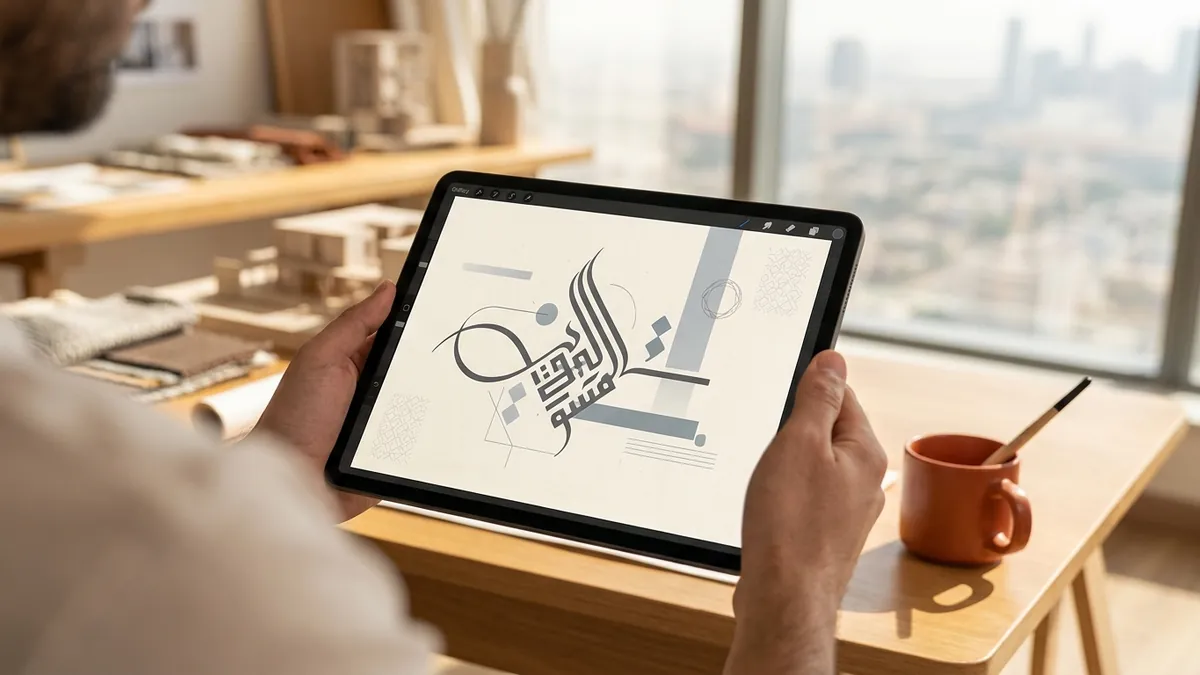
Arabic typography is an art form rooted in centuries of calligraphic mastery. In contemporary brand design, selecting appropriate Arabic typefaces requires balancing legibility with authentic aesthetic character.
Avoid generic system fonts like Arial Arabic or simplified digital translations, which lack visual sophistication. Select modern Arabic typefaces (such as custom Naskh, Kufic, or geometric display fonts) engineered specifically to harmonize with English brand fonts in weight, x-height, and visual personality.
Designing dual-language collateral demands precise structural balance. Because Arabic reads right-to-left (RTL) and English reads left-to-right (LTR), visual layouts must mirror gracefully without compromising grid hierarchy or visual flow.
Visual Symbolism: Architectural Motifs and Regional Topography
Integrating subtle visual motifs inspired by regional architecture and natural topography creates immediate subconscious brand alignment. Traditional Mashrabiya geometric latticework, dune contours, falcon iconography, and palm silhouettes carry deep cultural resonance.
However, designers must avoid heavy-handed, stereotypical visual cliches. Modern GCC design favors subtle abstract interpretations—such as translating Mashrabiya geometry into minimalist vector patterns or converting desert dune lines into fluid brand graphic accents.
This elevated approach honors cultural roots while presenting a modern, forward-thinking aesthetic suitable for global commercial markets.
Navigating Imagery Standards and Regional Photography Norms
Photography and visual imagery choices significantly impact brand perception across Dubai, Abu Dhabi, and Saudi Arabia. Imagery must reflect the authentic diversity of the modern GCC workforce and lifestyle while maintaining high cultural respect.
Ensure corporate and lifestyle photography represents local national dress (Kandura and Abaya) accurately, using authentic models rather than stock photography featuring incorrect regional attire variations. Balance national representation with multicultural expat imagery to reflect real-world commercial environments.
Prioritize photography featuring natural lighting, architectural grandeur, and sophisticated styling, avoiding overly staged or culturally insensitive visual setups.
Adapting Design Systems for Regional Digital Experiences
Extending GCC brand design systems into digital user interfaces (websites, mobile applications, and enterprise software) requires meticulous user experience planning. Dynamic RTL language switching requires fluid component mirroring across navigation bars, form fields, card layouts, and button placements.
Font size hierarchy must be adjusted for Arabic digital text, as Arabic script requires slightly larger point sizes and line-height spacing than English to maintain optimal digital legibility.
Investing in responsive, culturally optimized UI/UX design guarantees friction-free digital interactions for all regional user segments.
"Great design respects heritage while defining the future. Honor the culture, elevate the brand." — BAZ Team
Key Takeaways
- Color choices in the GCC carry deep symbolic value: emerald green (heritage), gold/sand (prestige), and sapphire (trust).
- Select bespoke Arabic typefaces that harmonize in visual weight and personality with corresponding English fonts.
- Abstract traditional architectural motifs (Mashrabiya, dune lines) rather than relying on heavy-handed visual cliches.
- Use authentic regional photography reflecting accurate national dress and multicultural GCC business environments.
- Ensure digital UI components, line-heights, and grid hierarchies mirror seamlessly for right-to-left (RTL) Arabic switching.
Looking to elevate your brand design for prestigious GCC and UAE audiences? Explore BAZ Branding & Identity Design Services.